
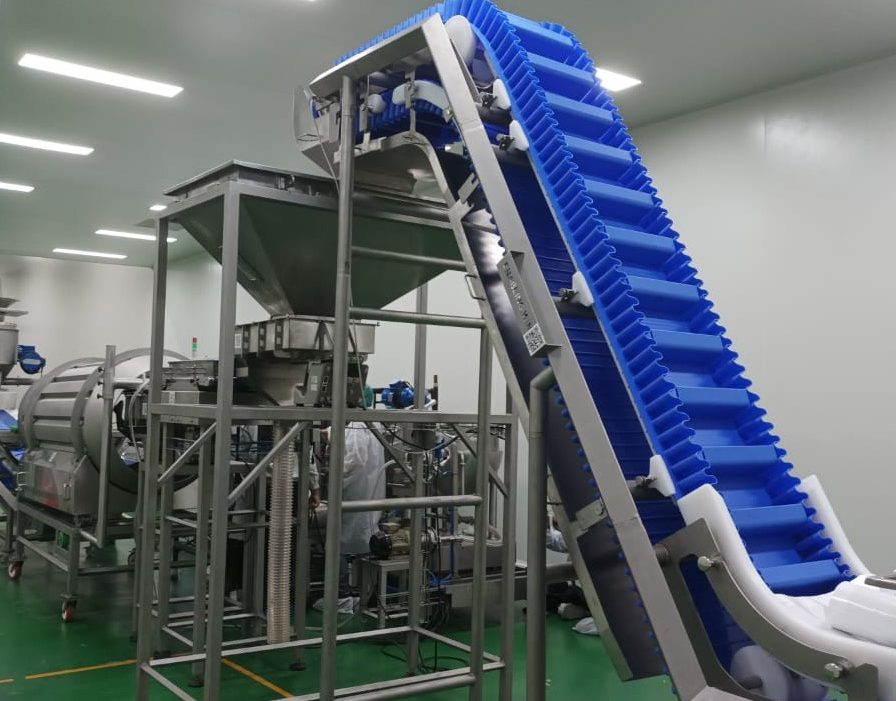
Most food plant managers know when something is wrong. Production targets are missed. Cleaning takes too long. Maintenance calls keep coming. But the root cause isn’t always obvious — and more often than not, it traces directly back to the conveyor system — quietly dragging down your conveyor line efficiency.
Conveyors are the backbone of your production line. When they work well, everything flows. When they don’t, the whole line suffers — and the costs hide across maintenance logs, cleaning records, and missed throughput targets.
Here are five signs your conveyor line efficiency is silently slipping — and what each one is costing you.
Sign 1: Cleaning Takes More Than One Hour Per Shift
If your sanitation team spends more than an hour cleaning a single conveyor, something is wrong with the design — not the team.
Hygienic conveyor systems are engineered for fast, repeatable cleaning. Open frames with no hollow sections, solid belts with no fabric layers, and minimal fasteners all contribute to cleaning times of 20–40 minutes per conveyor. Industry benchmarks from EHEDG-compliant conveyor designs consistently support this range. ¹
When cleaning takes 90 minutes or two hours, it usually means the conveyor has ledges where water pools, hollow tubes where bacteria can grow, or a belt material that requires manual scrubbing rather than pressure washing.
The hidden cost: every extra hour of cleaning is an hour of production capacity you are not using. On a two-shift operation running 250 days a year, an extra hour of cleaning per shift per conveyor represents 500 hours of lost production annually.
Sign 2: You Have Unexplained Product Slowdowns at Transfer Points
If your line runs smoothly through processing equipment but slows down at conveyor transfer points, the conveyor is your bottleneck.
Transfer points — where product moves from one conveyor to another, or from a machine onto a belt — are the most common source of line inefficiency in food plants. Poor transfer design causes product to tip, jam, gap, or accumulate, forcing operators to intervene manually and breaking the flow of the entire line.
Well-designed conveyor systems treat every transfer point as an engineering problem. The angle, height, belt speed differential, and guide rail positioning are all calculated to ensure smooth, uninterrupted product flow. If your operators are regularly stationed at conveyor transfer points to manually correct product movement, that is a design problem — and it is costing you both efficiency and direct labor.
Sign 3: Your Belt Needs Replacement More Than Once a Year
Frequent belt replacement is one of the clearest signals of a conveyor that was not specified correctly for its environment.
Food manufacturing environments are demanding. Belts are exposed to frequent washdowns with cleaning chemicals, temperature fluctuations, product acids, and continuous mechanical stress. A belt not selected specifically for these conditions will degrade quickly. According to Intralox, a correctly specified belt matched to the product type, cleaning regime, and line speed should achieve significantly longer service life than a generic food-grade belt selected on price alone. ²
Frequent belt changes also carry a food safety risk: a belt that is degrading is shedding material. In a Post-CCP environment, that is a contamination hazard that no cleaning protocol can fully mitigate.
Sign 4: Recurring Warnings on Internal Food Safety Audits
If your conveyor systems consistently flag during internal hygiene audits — standing water, visible residue, inaccessible cleaning areas — the problem is not your cleaning protocol. The problem is your equipment.
Audit findings related to conveyors typically include: hollow frame sections that cannot be drained, belt support surfaces with gaps that trap product, drive components that cannot be accessed for cleaning, and belt tensioning systems with exposed threads.
These are design failures, not maintenance failures. According to GFSI audit data, equipment cleanability is one of the most frequently cited non-conformances across BRC and SQF certification programs. ³ No amount of increased cleaning frequency will make a poorly designed conveyor pass a rigorous food safety audit.
If your conveyor is regularly flagged, it is time to assess whether the system is fit for purpose — not just whether your team is cleaning it correctly.
Sign 5: Line Speed Capped — Conveyor Line Efficiency Lost to Accumulation
If you regularly see product accumulating — piling up, jamming, or backing up — between conveyor sections, your line is operating below its designed capacity.
Accumulation between conveyors usually means one of three things: belt speed mismatch between sections, insufficient accumulation buffer at key points, or a conveyor that is too narrow for the product flow at full line speed.
These are solvable engineering problems. Properly designed accumulation conveyors — sized for your line speed and product dimensions — prevent backup and allow your processing equipment to run at rated capacity.
A line that constantly backs up is a line that never achieves its throughput potential, regardless of how well the processing machines themselves perform.
How to Recover Lost Conveyor Line Efficiency
If you recognise one or more of these signs in your plant, the first step is a structured line assessment — mapping each conveyor’s position, cleaning performance, transfer efficiency, and contribution to overall line speed.
At Enabling.Win, that is exactly how we start every project. We walk your line, document what we find, and provide a clear picture of where your conveyor system is costing you efficiency — before we recommend any solution.
Summary
Conveyor line efficiency rarely collapses dramatically — it erodes quietly across cleaning overruns, transfer-point interventions, belt replacements, and audit findings. If any of the five signs above are present in your facility, the root cause is almost certainly equipment design, not operator performance. The good news: every one of these problems is solvable with the right conveyor specification.
Sources
1. European Hygienic Engineering and Design Group (EHEDG). EHEDG Guideline Document 43 — Hygienic Design of Belt Conveyors for the Food Industry. https://www.ehedg.org
2. Intralox. Belt Selection and Lifecycle Performance in Food Manufacturing Environments. https://www.intralox.com
3. Global Food Safety Initiative (GFSI). GFSI Benchmarking Requirements — Equipment Hygiene. https://www.mygfsi.com