
If you manage a food manufacturing plant, you already know that hygiene is non-negotiable. Regulators demand it. Customers expect it. And one contamination incident — often traced back to a poorly specified hygienic conveyor belt — can shut down an entire production line or trigger a recall that costs millions.
But here’s what many plant managers miss: your conveyor belt is one of the highest-risk contact points in your entire facility — and most conventional belts were never designed with food hygiene in mind.
So what exactly is a hygienic conveyor belt, and how is it different from a standard one? This guide answers that question clearly, so you can make better decisions for your line.
Why Standard Belts Fall Short of Hygienic Conveyor Belt Standards
Walk into most food manufacturing plants across Southeast Asia and you’ll find conveyor belts selected on a single criterion: price.
The result? Belts with fabric layers that trap moisture and bacteria. Frames with hollow sections where food particles accumulate. Joints and bolt holes that are impossible to clean properly — no matter how long your sanitation team spends on them.
These are not hygienic conveyor belts. They are standard industrial conveyor belts running in a food environment. And that difference matters enormously — both for food safety and for the long-term cost of running your line.
What Makes a Hygienic Conveyor Belt Truly Effective?
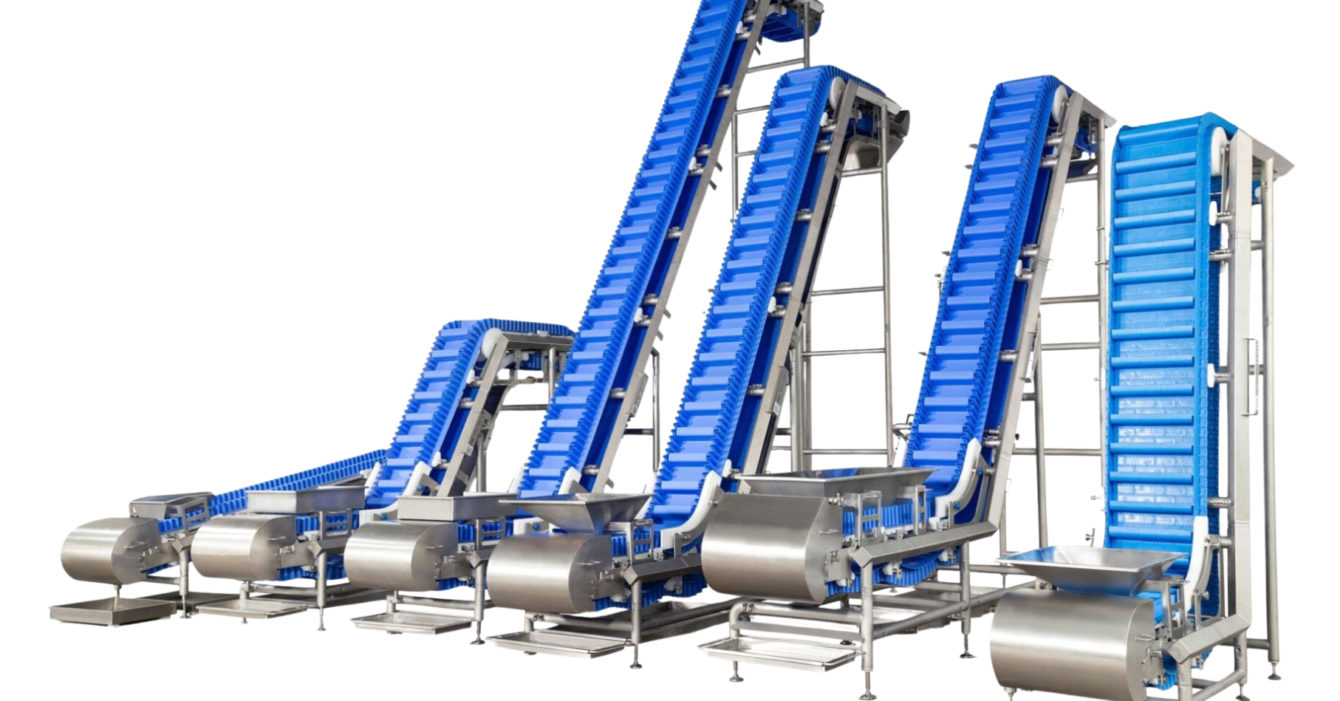
A hygienic conveyor belt is not simply a belt made from food-safe materials. It is a complete system — belt, frame, drives, and supports — engineered from the ground up around one principle: easy, effective, and repeatable cleaning.
The European Hygienic Engineering and Design Group (EHEDG), the leading authority on hygienic equipment design, defines hygienic design as equipment that can be reliably cleaned to a microbiologically acceptable level. That standard applies to every component — not just the belt surface. ¹
Here are the defining characteristics of a truly hygienic conveyor belt system:
- Solid, Single-Layer Belt Material – Hygienic belts are made from solid thermoplastic or monolithic materials — not fabric-reinforced (plied) belts. Plied belts have internal layers that absorb moisture and harbor bacteria even after cleaning. A solid belt has no internal structure to trap contamination.
- Open Frame Construction – The conveyor frame should have no hollow tubes, no internal cavities, and no unnecessary ledges where food debris or water can collect. Open-leg designs with smooth, rounded surfaces are the standard in hygienic engineering. 21 CFR 117.40 requires that equipment be designed and constructed so as to be adequately cleanable, and paragraph (d) applies this directly to conveying systems. 2
- Minimal Fasteners and Bolt Holes – Every bolt hole is a potential contamination point. Hygienic conveyor design minimizes fasteners, uses flush-mounted hardware, and eliminates exposed threads wherever possible.
- Cleanability as a Design Requirement – Hygienic design means equipment can be cleaned without disassembly or tools — if a conveyor has to be taken apart every shift to be cleaned properly, the design is doing the sanitation team’s job for them, badly.
- Food-Grade Materials Throughout – Every component that could contact food — or that cleaning chemicals could reach — must be made from food-grade approved materials. This includes belts, rollers, side guides, cleats, and frame coatings. Relevant standards include FDA 21 CFR and EU Regulation 10/2011 for food contact materials.
Why It Matters: The Real Cost of Non-Hygienic Conveyor Design
Plant managers often justify standard conveyor belts because they cost less upfront. But the true cost looks very different when you factor in the full picture.
Cleaning time. You already know how long your sanitation team spends on each conveyor. The question worth asking is why. If the answer involves disassembling guards, scrubbing belt edges by hand, or waiting for water to drain out of frame sections, that time is a design cost, not a labour cost — and no change to your cleaning procedure will recover it. Multiply the difference against your own shift pattern and you have the real number for your plant.
Failed audits. Food safety audits — whether internal, customer-driven, or regulatory — are increasingly rigorous. A conveyor that cannot demonstrate cleanability will fail — and a failed audit can cost you a customer relationship worth far more than the price of an upgraded conveyor.
Contamination incidents. The consequences of a contamination event range from costly product recalls to facility shutdowns. In Southeast Asia, where export relationships depend on consistent food safety certification, the stakes are higher still — a certification lost is a market lost.
Maintenance downtime. Non-hygienic belts wear faster under frequent aggressive washdowns. Replacement cycles are shorter, maintenance is more frequent, and unplanned downtime accumulates.
Pre-CCP vs Post-CCP: Where Hygiene Requirements Are Highest
Not all positions in a food production line carry the same hygiene risk. Understanding Critical Control Points (CCPs) helps you prioritize where hygienic conveyor design matters most.
Post-CCP conveyors are positioned after the critical control point — typically after cooking, pasteurization, or another kill step. At this stage, the product is in its final processed state. Contamination here is the most serious risk because there is no further kill step to eliminate it. Post-CCP conveyors require the highest level of hygienic design.
Pre-CCP conveyors handle product before it reaches the kill step. While hygiene is still important, the risk profile is different. These conveyors still require food-grade, cleanable design — but the specification may reasonably differ from a Post-CCP position.
Understanding where each conveyor sits relative to your CCPs is the foundation of a smart, cost-effective hygiene specification.
Five Questions to Ask When Evaluating a Hygienic Conveyor Belt
Before purchasing any conveyor system for a food manufacturing application, ask your supplier these five questions:
- What belt material is used, and is it solid or plied? Ask for the material specification and food-grade certification documentation.
- How is this conveyor cleaned? Ask for a step-by-step cleaning procedure and an honest estimate of cleaning time per shift.
- Are there any hollow sections in the frame or drive components? If yes, ask how those areas are sealed or drained.
- What is the expected belt replacement cycle under regular food plant cleaning conditions? This tells you the true cost of ownership.
- Has this design been used in a similar food manufacturing application? Ask for references or case studies from comparable plants.
A supplier who cannot answer these questions confidently is not a specialist in hygienic conveyor design.
The Enabling.Win Approach
At Enabling.Win, we engineer conveyor systems exclusively for food manufacturers. Every project begins with a single question: where does this conveyor sit in your process, and what does that mean for hygiene, cleanability, and uptime?
We map your production line, identify your CCP positions, understand your cleaning protocols, and specify a conveyor that is genuinely fit for your application — not just compliant on paper.
Our clients across the Philippines, Indonesia, Vietnam, Thailand, Singapore, and Malaysia have replaced non-hygienic conveyor systems with properly engineered ones — and the difference shows up in audit performance and in how much of a shift goes to sanitation rather than production.
Summary
A hygienic conveyor belt is not simply a belt made from food-safe materials. It is a complete system designed around cleanability, contamination prevention, and ease of maintenance. Selecting the right conveyor for each position in your line is one of the highest-leverage decisions a food plant manager can make. Get it right, and you’ll spend less time cleaning, pass more audits, and run a more efficient production line.
Sources
- European Hygienic Engineering and Design Group (EHEDG). EHEDG Guideline Document 8 – Hygienic Design Principles, 4th edition. https://www.ehedg.org
- U.S. Food and Drug Administration. 21 CFR 117.40 — Equipment and utensils. Current Good Manufacturing Practice, Hazard Analysis, and Risk-Based Preventive Controls for Human Food. https://www.ecfr.gov/current/title-21/chapter-I/subchapter-B/part-117/subpart-B/section-117.40
- European Commission. Regulation (EU) No 10/2011 on plastic materials and articles intended to contact food. https://eur-lex.europa.eu