
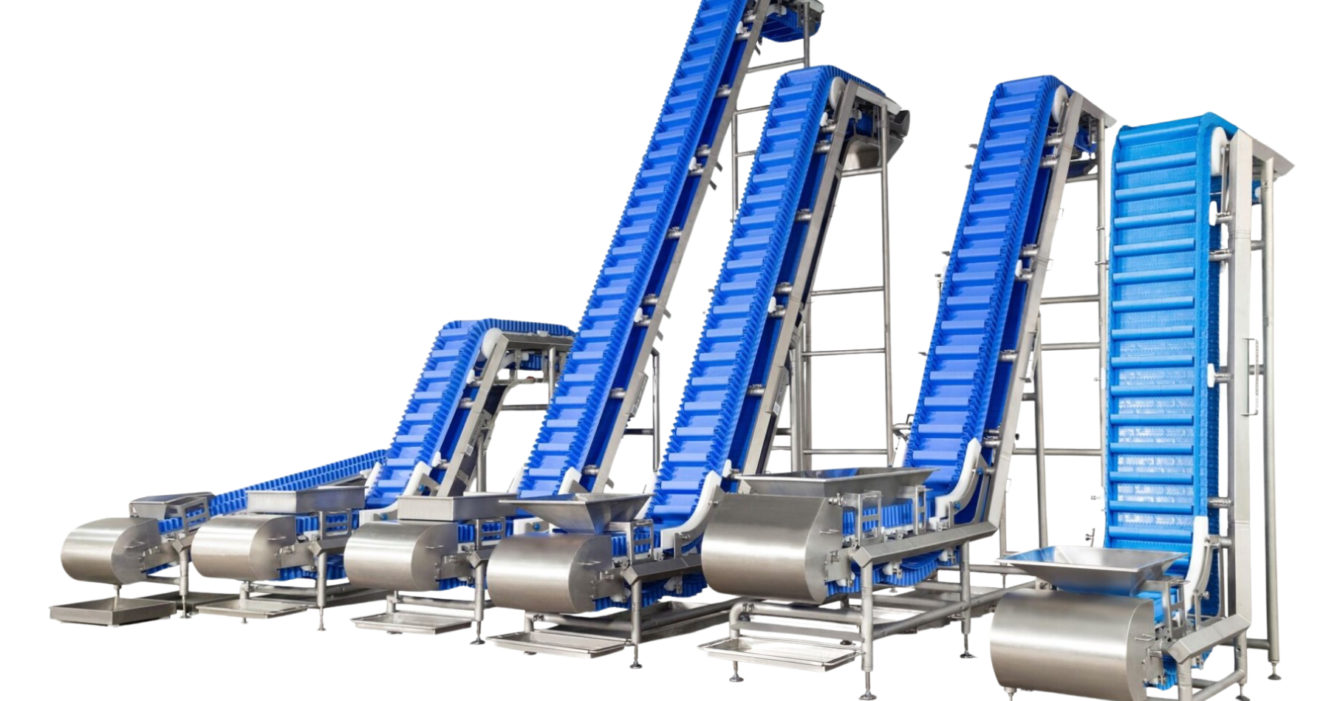
The term industrial conveyor systems covers an enormous range of equipment – from mining conveyors to automotive assembly lines to the conveyor belts in food manufacturing plants.
The engineering principles are broadly similar. The specifications are fundamentally different.
When a conveyor system operates in a food manufacturing environment, it must meet requirements that have no equivalent in general industrial applications: hygienic design standards, food-contact material approvals, cleanability under aggressive washdown conditions, and compatibility with food safety audit frameworks.
The Core Difference: Cleanability Is Not Optional
In most industrial applications, a conveyor is cleaned when it needs to be. In a food manufacturing environment, a conveyor is cleaned on a fixed schedule – often at the end of every production shift – regardless of whether it looks dirty.
This is a food safety requirement. Bacteria do not become visible before they reach dangerous concentrations.
Standard industrial conveyor designs – with hollow section frames, non-draining surfaces, and fabric belt constructions – fail this requirement by design. They were simply never engineered for food manufacturing conditions. 1
Material Specifications: From Industrial to Food-Grade
In food manufacturing, every material that could contact food must meet specific approval standards:
- FDA 21 CFR (United States) – specifying materials approved for food contact 2
- EU Regulation 10/2011 – the European standard for plastic food contact materials 4
- EHEDG design guidelines – covering hygienic design of belt conveyors 1
This applies not just to the belt, but to frame coatings, roller materials, side guide materials, fastener finishes, and lubricants used in drive components.
Frame Design: Open vs Hollow
Standard industrial conveyors are typically built with hollow section steel tubing. This is structurally efficient for general industrial applications.
In a food manufacturing environment, hollow frame sections are a hygiene failure point. Water and product residue accumulate inside where cleaning cannot reach. Bacteria establish biofilms in these enclosed, wet environments.
Hygienic conveyor frames use open-section profiles or solid-section materials that eliminate internal cavities entirely.
Drive and Bearing Design
Standard industrial conveyor drives use conventional bearing housings – open or lightly sealed, designed for periodic relubrication. In a food manufacturing environment, these housings are direct harborage points for bacteria.
Hygienic conveyor drives use fully sealed bearing housings. Drive motors used in food environments are typically IP65 or IP66 rated.
IP66 and IP69K test for different things. IP69K adds close-range, high-temperature jets to the test protocol, which is a harsher condition than most sanitation regimes will ever apply. The higher rating is margin, not a requirement to wash hotter.
What This Means for Plant Managers Evaluating Industrial Conveyor Systems
If you are evaluating whether a conveyor system is appropriate for a food manufacturing application, these are the questions that define the answer:
- Is the frame constructed from open-section or solid-section profiles, with no hollow sections that cannot be drained and cleaned?
- Are all food-contact materials certified to FDA 21 CFR or EU 10/2011?
- Are bearing housings fully sealed for wet washdown environments?
- Are drive components accessible for cleaning without tools?
- Has the complete system been used in a comparable food manufacturing application with a documented cleaning procedure?
A standard industrial conveyor will fail most of these questions. A properly specified food conveyor system will answer all of them.
The Enabling.Win Approach
At Enabling.Win, every conveyor system we supply is specified from the ground up for food manufacturing conditions. We do not adapt standard industrial equipment for food applications – we design complete hygienic systems matched to your product, your cleaning regime, and your CCP requirements.
Summary
Standard industrial conveyor systems are not suitable for food manufacturing environments without significant modification. The differences go beyond materials – they include frame construction, drive and bearing design, drainage, and cleaning compatibility. Every conveyor operating in a food manufacturing facility should be assessed against food-specific design standards.
Sources
- European Hygienic Engineering and Design Group (EHEDG). EHEDG Guideline Document 43 – Hygienic Design of Belt Conveyors for the Food Industry. https://www.ehedg.org
- U.S. Food and Drug Administration. 21 CFR Part 177 – Indirect Food Additives: Polymers. https://www.ecfr.gov/current/title-21/chapter-I/subchapter-B/part-177
- U.S. Food and Drug Administration. 21 CFR 117.40 – Equipment and utensils. https://www.ecfr.gov/current/title-21/chapter-I/subchapter-B/part-117/subpart-B/section-117.40
- European Commission. Regulation (EU) No 10/2011 on Plastic Materials and Articles Intended to Contact Food. https://eur-lex.europa.eu