
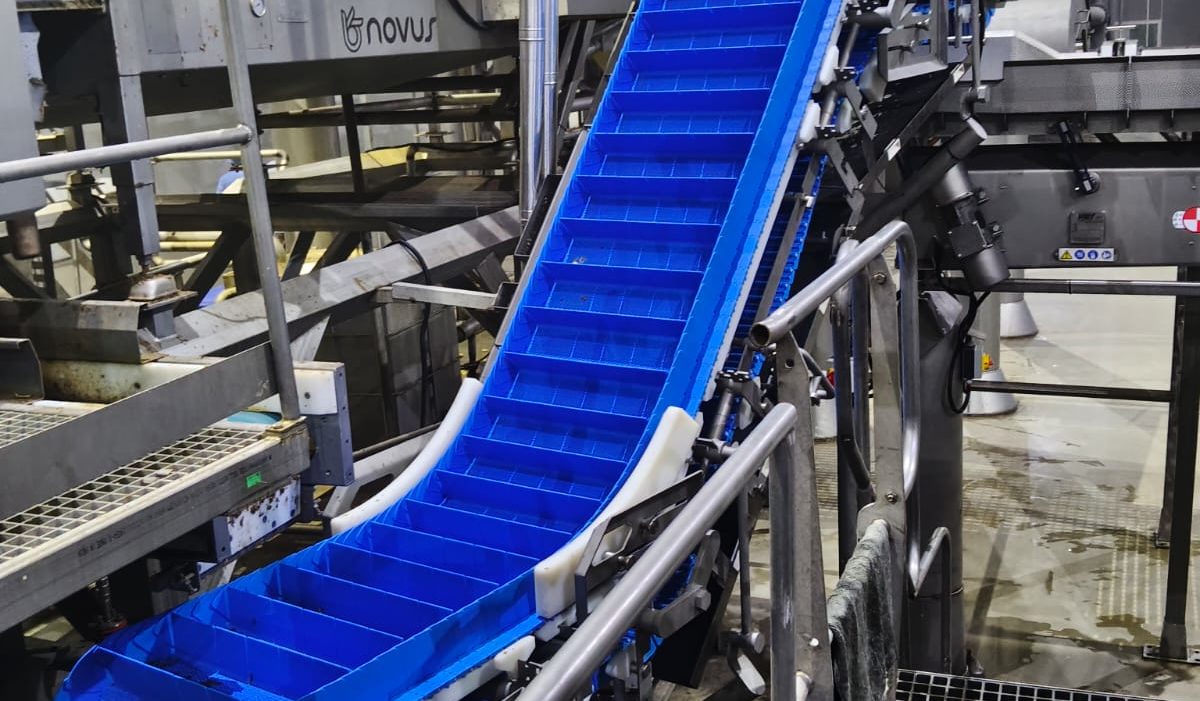
When plant managers and project engineers begin planning a conveyor system, one of the first layout decisions they face is the elevation question: does the product need to move horizontally, or does it need to change height between process stages? The answer determines whether you need an incline conveyor, a horizontal conveyor, or — in the majority of real-world food plants — a combination of both.
This article explains the key differences between the two configurations, when each is appropriate, and what unique hygiene and engineering considerations apply to incline conveyors in food manufacturing environments.
The Basic Distinction
A horizontal conveyor moves product along a flat plane — from one point to another at the same elevation. It is the simplest conveyor configuration and the most common.
An incline conveyor moves product upward (or downward) between two different elevations. It is used when process equipment, packaging machines, or accumulation areas are at different heights — which is the case in the majority of food plants.
Both types can be hygienic. Both can be non-hygienic. The distinction is in the design and specification, not the configuration.
When You Need an Incline Conveyor
Incline conveyors are needed in food plants whenever:
- Product must be elevated from a processing machine to a packaging line at a higher level
- Product must descend from a processing area to a lower packaging or accumulation area
- Plant layout constraints require elevation changes to avoid crossing product flows
- Product needs to be conveyed into or out of overhead equipment such as fryers, ovens, or spiral coolers
The angle of incline is a critical specification, and it is determined by the product, not by the conveyor. A smooth belt relies on friction alone, so the achievable angle depends on how your product behaves against the belt surface. Wet, oily, or round products slide at angles where flat product sits comfortably. Where the layout demands a steeper climb than the product will hold, cleated belts or side walls become part of the specification rather than an accessory to it.
Hygiene Considerations Specific to Incline Conveyors
Incline conveyors present hygiene challenges that horizontal conveyors do not:
Drainage. Water, cleaning chemicals, and product residue run down the incline under gravity during cleaning. The conveyor frame must be designed so that drainage flows away from the belt — not into bearing housings, drive components, or hollow frame sections. Drainage is not a detail. In BRCGS’s 2024–2025 audit data, the most frequently cited non-conformity worldwide was premises and equipment not maintained in a clean and hygienic condition, with equipment design and construction second — 8,000 findings between them.2
Belt tension. Incline conveyors carry a gravitational load on the return side of the belt that horizontal conveyors do not. This affects belt tension requirements, drive sizing, and the wear rate on belt support components. A belt correctly tensioned for a horizontal run may be under-tensioned on an incline, leading to premature wear or belt tracking issues.
Return belt hygiene. On an incline conveyor, the return belt — the underside of the belt travelling back from the discharge end to the infeed — carries product residue that can drip onto the frame or floor below. Return belt scrapers and drainage management are important design elements that are frequently omitted in lower-specification designs.
Transfer point geometry. The discharge end of an incline conveyor — where product leaves the belt and transfers to the next conveyor or process stage — requires careful geometric design to ensure product transfers cleanly without bridging, spillage, or jamming. The discharge height, belt speed differential, and guide rail configuration all affect transfer efficiency.
When a Horizontal Conveyor Is the Right Choice
Not every conveyor application needs elevation change. Horizontal conveyors are the right choice when:
- Product moves between equipment at the same height
- Accumulation is needed between process stages at the same elevation
- A buffer conveyor is required between two machines running at different speeds
- A transfer conveyor connects two pieces of equipment side by side
Horizontal conveyors are generally simpler to design, easier to clean, and lower in capital cost than incline units of equivalent length. Where the layout permits a horizontal run, it is usually the preferable choice from both a cost and hygiene standpoint.
The Combination Approach
In practice, most food production lines require both horizontal and incline conveyors — interconnected as part of a coherent system. A typical snack food line, for example, might include:
- A horizontal conveyor from the infeed hopper to the seasoning drum
- An incline conveyor elevating seasoned product to an elevated packaging level
- A horizontal accumulation conveyor at the packaging stage
- A decline conveyor from the packaging line to the palletizing area at floor level
The key to a well-functioning conveyor system is not selecting the right conveyor type in isolation — it is mapping the entire line and ensuring that every transition between conveyor sections is engineered for smooth, hygienic product flow. Each handover point between an incline and a horizontal section is a potential source of product jam or transfer inefficiency if not designed carefully.
How Enabling.Win Approaches Incline Conveyor and Horizontal Conveyor Design
At Enabling.Win, we begin every project with a full line mapping exercise. We document every elevation change, every process machine height, every packaging line position, and every transfer point — before we specify a single conveyor.
This ensures that every incline and horizontal conveyor in the system is specified as part of a coherent flow design, not as isolated pieces of equipment purchased independently. The difference this makes to transfer efficiency and overall line performance is significant.
Summary
The choice between an incline and horizontal conveyor is determined by your plant layout and the elevation differences between process stages — not by preference. Both types can be designed to full hygienic standards. Incline conveyors require specific attention to drainage, belt tension, return belt management, and transfer point geometry that horizontal conveyors do not. In most food plants, you will need both — and the performance of the system depends on how well they are designed to work together.
Sources
1. European Hygienic Engineering and Design Group (EHEDG). EHEDG Guideline Document 43 — Hygienic Design of Belt Conveyors for the Food Industry. https://www.ehedg.org
2. BRCGS. Achievements, Progress and Impact 2024–2025. https://www.brcgs.com