
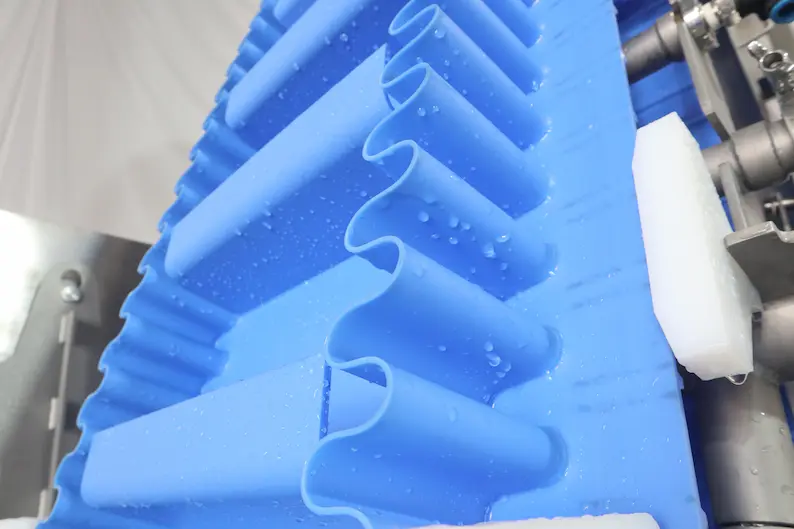
If you manage a food manufacturing facility, the word hygienic appears constantly – on equipment brochures, audit checklists, and supplier presentations. But what does it actually mean when applied to a hygienic conveyor system?
The answer matters more than most plant managers realise. A conveyor described as hygienic by a supplier may meet a very different standard than one described as hygienic by an auditor – and the gap between the two can show up as a non-conformance at your next certification audit. This guide explains what hygienic conveyor system design actually requires, which standards define it, and how to evaluate whether your current equipment meets those standards.
Why Food-Safe and Hygienic Are Not the Same Thing
The most important distinction to understand is this: food-safe and hygienic are not interchangeable terms.
A food-safe conveyor uses materials approved for contact with food – belts, rollers, and frame coatings that will not leach harmful substances into your product. This is the minimum standard. Most conveyors sold for food applications meet it.
A hygienic conveyor system goes further. It is engineered so that every component can be cleaned thoroughly, quickly, and repeatedly – to a microbiologically acceptable level – as part of normal production operations.
The European Hygienic Engineering and Design Group (EHEDG) defines hygienic design as equipment that can be cleaned to a microbiologically safe level. 1 That definition includes the design of the frame, the drive components, the belt supports, and the drainage – not just the belt material.
A conveyor can use food-grade materials and still be impossible to clean effectively. That is not a hygienic conveyor system.
The Four Pillars of a Hygienic Conveyor System
Hygienic conveyor systems are defined by four interconnected design requirements:
1. Cleanability – Every surface of the conveyor must be accessible for cleaning without disassembly. Cleaning agents must be able to reach, act on, and be rinsed from all surfaces during a standard cleaning cycle.
2. Drainability – After cleaning, water and cleaning chemicals must drain completely from the conveyor. Standing water is a growth medium for bacteria – particularly Listeria monocytogenes, which can form persistent biofilms on wet stainless-steel surfaces. 2
3. No Harborage Points – A harborage point is any area where food residue, moisture, or bacteria can accumulate beyond the reach of cleaning. Common examples include hollow frame tubes, exposed bolt threads, fabric belt layers, and unsealed bearing housings. EHEDG design principles are built around eliminating harborage points wherever the design allows. 1
4. Material Integrity – Every material used in the conveyor must maintain its integrity under the cleaning conditions used in your facility – including chemical type, concentration, temperature, and pressure.
How Hygienic Standards Apply Across Your Line
Not every conveyor in your facility requires the same level of hygienic design. The position of each conveyor relative to your critical control points defines its hygiene risk profile.
Post-CCP conveyors – those handling product after the kill step – require the full application of hygienic design principles. Contamination introduced at a Post-CCP position cannot be eliminated by any downstream process step.
Pre-CCP conveyors still require food-grade materials and cleanable design, but the specification may reasonably differ in ways that affect capital cost and material selection.
The key is to map every conveyor in your facility against your HACCP plan and specify each one according to its actual risk profile.
Common Design Failures to Look For in Your Current Equipment
When assessing whether your existing conveyor systems are truly hygienic, look for these common design failures:
- Hollow frame tubes – tap the frame. If it sounds hollow, water and bacteria can accumulate inside.
- Exposed bolt threads – any exposed thread is a potential harborage point.
- Fabric-reinforced belts in Post-CCP positions – an unacceptable hygiene risk regardless of cleaning frequency.
- Unsealed bearing housings – direct harborage points for bacteria and product residue.
- Inaccessible drive components – if your team needs more than basic hand tools to access the drive end, the design is not hygienic.
The Enabling.Win Approach to Hygienic Conveyor Systems
At Enabling.Win, we design hygienic conveyor systems from first principles, beginning with your process, your cleaning protocol, and your CCP map, not with a standard catalogue item.
Every system we supply is assessed against EHEDG design principles and matched to the specific hygiene requirements of its position in your line.
Summary
A truly hygienic conveyor system is defined by four design requirements: cleanability, drainability, absence of harborage points, and material integrity. Food-safe materials are a minimum – not a guarantee of hygiene performance. Every conveyor in your facility should be assessed against these criteria relative to its CCP position.
Sources
1. European Hygienic Engineering and Design Group (EHEDG). EHEDG Guideline Document 43 – Hygienic Design of Belt Conveyors for the Food Industry. https://www.ehedg.org
2. U.S. Food and Drug Administration. Draft Guidance for Industry: Control of Listeria monocytogenes in Ready-To-Eat Foods. https://www.fda.gov/regulatory-information/search-fda-guidance-documents