
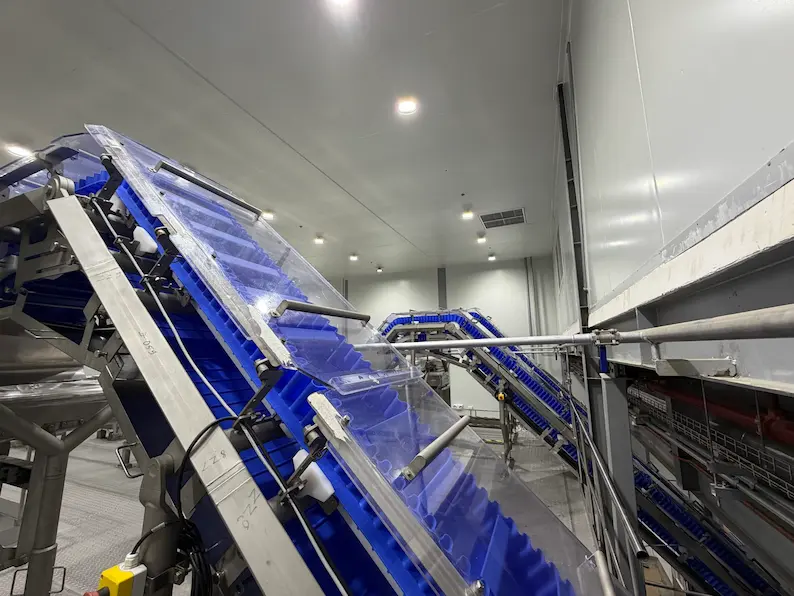
Choosing a food conveyor system sounds straightforward. You need to move product from point A to point B. How complicated can it be?
In practice, the answer is: quite complicated – and the consequences of getting it wrong are significant. A conveyor system that is under-specified for its food safety requirements, incorrectly sized for its application, or poorly matched to your cleaning protocol will cost you more in downtime, maintenance, and audit risk than a correctly specified system would have cost to purchase.
This article provides a structured framework for evaluating and selecting a food conveyor system for a specific production line application.
Step 1: Define the Application Before You Define the Equipment
The most common mistake in conveyor selection is starting with the equipment – browsing catalogues, requesting quotes, and comparing prices – before the application is fully defined.
A food conveyor system must be specified against these parameters before any equipment selection can begin:
- What product is being conveyed? Weight, dimensions, fragility, moisture content, temperature, and surface texture determine the appropriate belt type, belt speed, and conveyor geometry.
- What is the throughput requirement? Line speed combined with product dimensions determines the belt width and conveyor length needed.
- What is the CCP position of this conveyor? The position relative to your critical control points determines the hygiene specification.
- What is the cleaning regime? Cleaning chemicals must be cross-referenced against belt material chemical resistance data before a belt type is selected.
- What are the layout constraints? Available floor space, ceiling height, and the positions of adjacent equipment determine whether a horizontal, incline, or combination layout is required.
Step 2: Match the Belt Type to the Application
Belt selection is one of the most consequential decisions in food conveyor specification:
- Plied belts are not appropriate Post-CCP — the internal fabric layer absorbs moisture and cannot be inspected or verified clean. Beyond that, the deciding factor is surface geometry. A continuous, joint-free belt is inherently easier to clean and verify than one with hinge rods and module joints. Where a modular belt is specified for drainage or load reasons, the joint design and the cleaning protocol have to be validated for that position.
- Metal mesh belts are specified for thermal processing applications.
Step 3: Specify the Frame to Match the Hygiene Requirement
The belt is only one component of the conveyor system. For Post-CCP and high-care applications, frame specification should include open-section or solid-section frame profiles with no hollow tubes; sloped surfaces and drainage channels; flush-mounted or eliminated fasteners in food-contact zones; sealed bearing designs; and drive components accessible for cleaning without tools. 1
Step 4: Verify the Complete Food Conveyor System
A food conveyor system is not a collection of independent components. Specifying each component independently creates compatibility risks that are difficult to anticipate and expensive to resolve after installation.
The most reliable approach is to specify a complete system from a supplier with demonstrated experience in food manufacturing applications – one who can provide a documented cleaning procedure, a maintenance schedule, and evidence of performance in comparable applications.
Step 5: Calculate Total Cost of Ownership
The purchase price of a conveyor system is the least accurate predictor of its true cost. Total cost of ownership over a realistic service life includes: belt replacement cost and frequency; cleaning labour time per shift; maintenance labour and spare parts; downtime cost; and audit risk cost.
A conveyor that costs 20% more to purchase but takes a fraction of the time to clean and eliminates recurring audit findings will deliver a lower total cost than the cheaper alternative in every scenario.
The Enabling.Win Approach to Food Conveyor System Selection
At Enabling.Win, our selection process begins with a structured assessment of your application – not with a catalogue. We define the product, the CCP position, the cleaning regime, and the layout requirements before we specify any equipment.
Summary
Selecting the right food conveyor system requires defining the application before selecting the equipment. Belt type and frame specification must be matched to the hygiene requirement of the specific position. Total cost of ownership over a realistic service life is a more reliable basis for equipment decisions than purchase price alone.
Sources
- European Hygienic Engineering and Design Group (EHEDG). EHEDG Guideline Document 43 – Hygienic Design of Belt Conveyors for the Food Industry. https://www.ehedg.org