
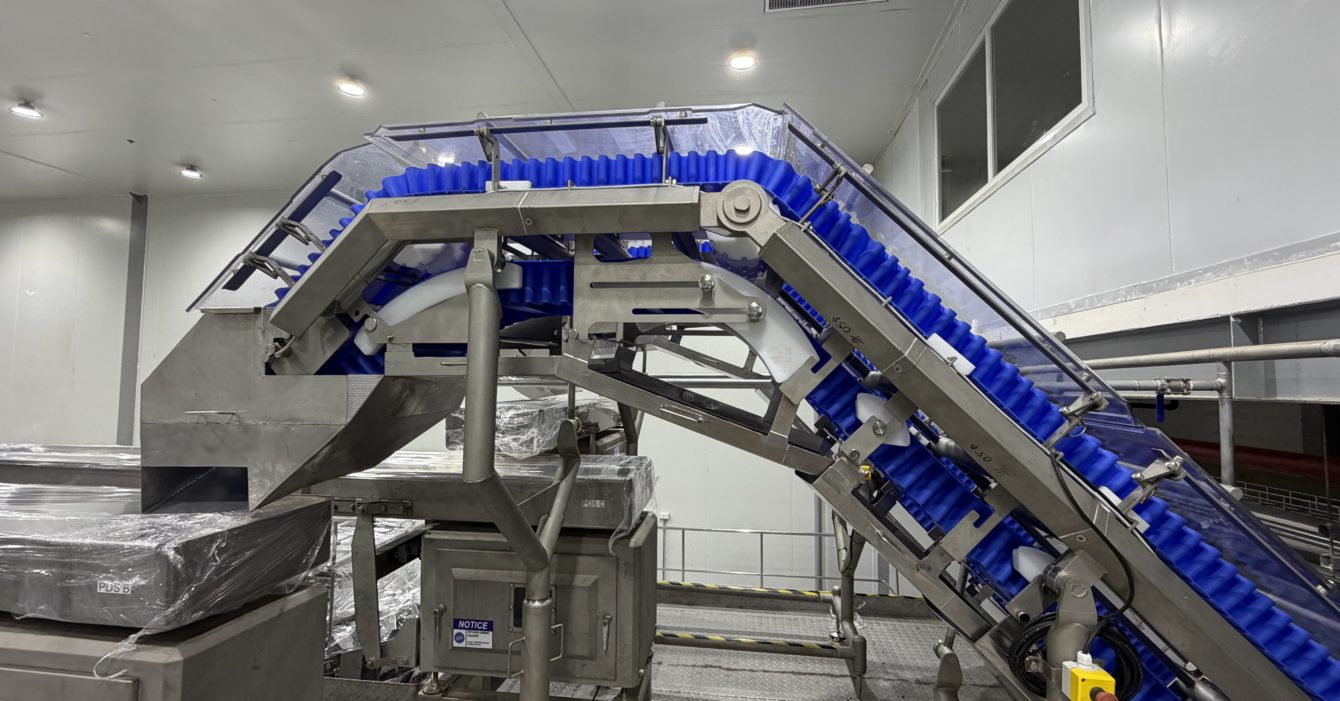
If you are responsible for a food manufacturing facility – whether as a plant manager, project engineer, or operations director – food industry conveyor systems are one of the most consequential decisions you make for your line.
Get it right, and your line runs at designed capacity with minimal cleaning time, strong audit performance, and predictable maintenance costs. Get it wrong, and you spend years managing the consequences: recurring audit findings, excessive cleaning overruns, premature belt failures, and transfer point inefficiencies.
This guide brings together the key principles from our entire content series on food industry conveyor systems – hygienic design, belt selection, CCP positioning, equipment integration, and audit compliance – into a single reference.
Part 1: Why Conveyor System Design Is a Food Safety Decision
In food manufacturing, the conveyor system is not simply a logistics tool. It is a food contact surface – and in Post-CCP positions, it is one of the highest-risk food contact surfaces in the entire facility.
A conveyor handling ready-to-eat product after a kill step operates in a zone where no downstream process will eliminate contamination introduced by the equipment. The US FDA has identified food contact surfaces – including conveyor systems – as a primary environmental reservoir for Listeria in manufacturing facilities. 1
Part 2: Hygienic Design Principles
A hygienic conveyor system is defined by four design requirements:
- Cleanability – every surface accessible for cleaning without disassembly.
- Drainability – water and cleaning agents drain completely from all surfaces by gravity.
- No harborage points – no gaps, crevices, hollow tubes, or overlapping surfaces where product residue or bacteria can accumulate.
- Material integrity – all materials maintain their integrity under the actual cleaning conditions used in the facility.
These principles are defined by EHEDG in Guideline Document 43, the most widely referenced standard for food conveyor design globally. 2
Part 3: Understanding CCP Positions
Post-CCP conveyors handle product after the kill step. They require the highest hygienic design standard — belt construction appropriate to the position, open-frame construction, sealed drives, and cleaning verification.
Pre-CCP conveyors handle product before the kill step. They require food-grade materials and cleanable design, but the specification may differ from Post-CCP equipment.
Mapping every conveyor against your HACCP plan and specifying each one according to its actual risk profile is the foundation of an effective and cost-efficient conveyor hygiene strategy.
Part 4: Belt Selection
Belt selection is the most consequential individual decision in conveyor specification. The key criteria, in priority order, are:
- CCP position – Plied belts are not appropriate Post-CCP — the internal fabric layer absorbs moisture and cannot be inspected or verified clean. Beyond that, the deciding factor is surface geometry. A continuous, joint-free belt is inherently easier to clean and verify than one with hinge rods and module joints. Where a modular belt is specified for drainage or load reasons, the joint design and the cleaning protocol have to be validated for that position.
- Product type – wet, acidic, or high-temperature products require different belt materials than dry ambient products.
- Cleaning regime – cross-reference belt material chemical resistance against your actual cleaning agents before specifying.
- Line speed and load – belt selection must account for the mechanical demands of the application.
Part 5: Equipment Integration
The three critical integration points are:
- Infeed geometry – belt speed, height, and width must match the processing machine’s infeed specification precisely.
- Discharge and transfer point design – discharge height, belt speed differential, and guide rail positioning must all be engineered for the specific product and line speed.
- Accumulation sizing – buffer conveyor capacity must be matched to the actual variation in machine cycle times and changeover durations.
Part 6: Cleaning and Audit Compliance
In BRCGS’s 2024–2025 audit data, Clause 4.11.1 — premises and equipment maintained in a clean and hygienic condition — was the most-cited non-conformity worldwide, at 4,715 findings. Clause 4.6.2, equipment design and construction based on risk of product contamination, was second at 3,322. 3
The most common audit findings related to conveyor systems are inaccessible areas on the frame or drive components; standing water after cleaning; belt damage creating harborage points; incorrect belt specification for CCP position; and inadequate cleaning records.
All these findings are preventable through correct equipment specification and documented cleaning procedures.
Making the Right Decision for Your Line
The right conveyor system for your line depends on your specific product, your CCP map, your cleaning regime, your layout, and your throughput requirements.
At Enabling.Win, we begin with a full line assessment – mapping your process, your HACCP plan, your cleaning protocol, and your layout constraints – before we specify a single conveyor.
Summary
Conveyor systems for the food industry require a different specification approach than general industrial equipment – because they are food safety assets, not just logistics tools. Hygienic design, CCP-appropriate specification, correct belt selection, integrated equipment design, and audit-compliant cleaning procedures are the foundations of a food conveyor system that performs over its full-service life.
Sources
- U.S. Food and Drug Administration. Draft Guidance for Industry: Control of Listeria monocytogenes in Ready-To-Eat Foods. https://www.fda.gov/regulatory-information/search-fda-guidance-documents
- European Hygienic Engineering and Design Group (EHEDG). EHEDG Guideline Document 43 – Hygienic Design of Belt Conveyors for the Food Industry. https://www.ehedg.org
- BRCGS. Achievements, Progress and Impact 2024–2025. https://www.brcgs.com