
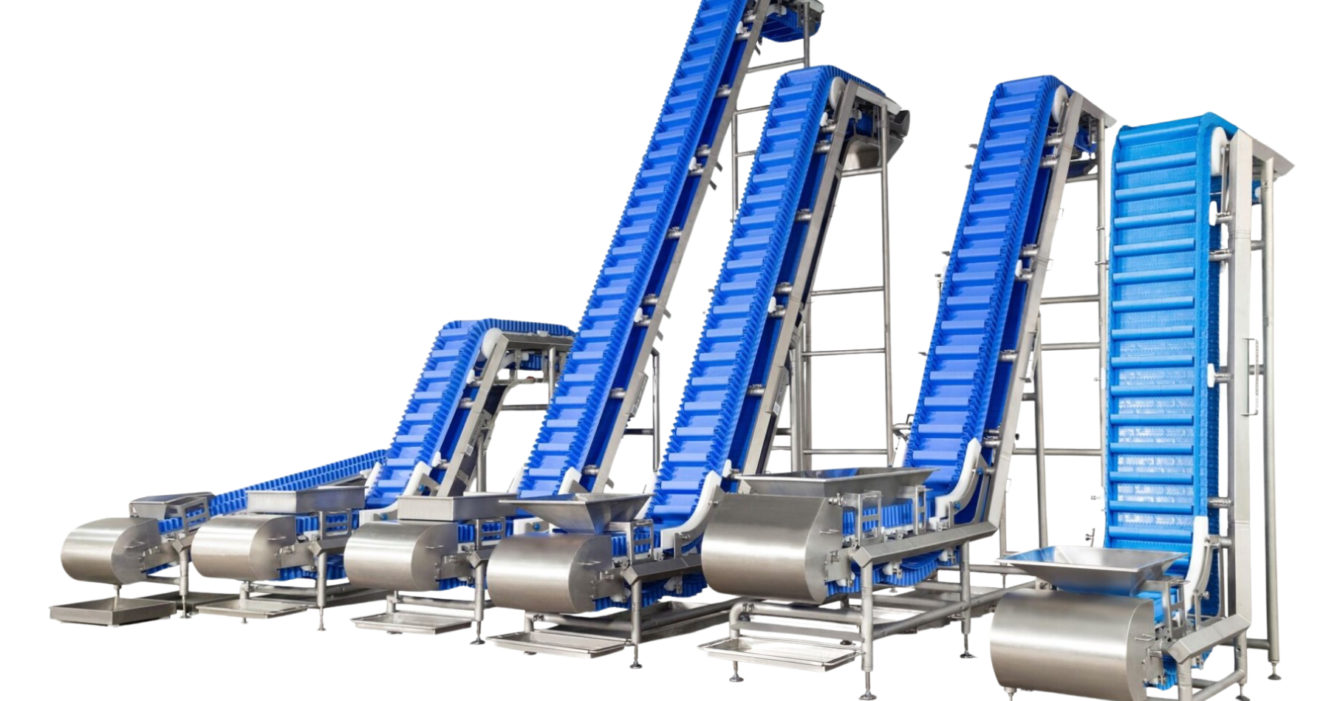
Food processing equipment – ovens, fryers, weighers, slicers, packaging machines – gets most of the attention during a production line project. Conveyor systems, by contrast, are often treated as connective tissue – the parts that link the important equipment together. This is one of the most reliable ways to end up with a production line that does not work as intended. The conveyor system is the backbone of your production line. Conveyor integration at every infeed, discharge, and transfer point determines whether your line runs at design capacity or constantly underperforms.
The Infeed: Matching Conveyor Output to Machine Input
Every processing machine has a defined infeed specification: the belt width, height, speed, and product orientation required for the machine to operate correctly. When the conveyor does not match these parameters precisely, the result is jams, product damage, line stoppages, and throughput below design capacity.
Common infeed integration failures include:
- Speed mismatch – belt speed must be calculated and matched to the machine’s rated throughput, not estimated.
- Height mismatch – transfer height must be engineered, not assumed.
- Width mismatch – belt width must account for product dimensions plus clearance.
Each of these failures is preventable if the conveyor system is specified in conjunction with the processing equipment – not after it is already on order.
The Discharge: Managing Transfer Point Geometry
The discharge point – where product leaves a conveyor and transfers to a machine, another conveyor, or a packaging line – is the most common source of line inefficiency in food plants.
A well-designed transfer point is engineered around a handful of variables: discharge height, belt speed differential, and guide rail positioning. Get those wrong and product bridges, tips, or jams at the handover. Get them right and the transfer stops being a place where things go wrong.
Poorly designed transfer points are among the most common causes of line efficiency loss we see in food plants.
Accumulation: Protecting Processing Equipment from Upstream Variation
No production line runs at perfectly constant speed. Without planned accumulation – conveyor buffer zones designed to absorb variations – line stoppages at one point cascade across the entire line.
Accumulation conveyors must be sized to match the known variation in machine cycle times and changeover durations.
The hygiene specification of accumulation conveyors depends on their CCP position. An accumulation conveyor in a Post-CCP zone requires the same hygienic design standard as any other Post-CCP conveyor.1
Cleaning Integration: Scheduling Around Process Equipment
Conveyor systems in food manufacturing are cleaned on a schedule aligned with production shifts. The cleaning sequence must be planned as part of the line design, not improvised after installation.
Integration requirements include: chemical compatibility between conveyor cleaning agents and adjacent process equipment; drainage management; and sequence and timing to prevent recontamination. The general principle is to clean from higher-hygiene areas toward lower-hygiene ones, so that soil and water don’t travel back onto surfaces you’ve already cleaned. 2
The Enabling.Win Conveyor Integration Approach
At Enabling.Win, we map the complete production line before specifying any conveyor system. We document every processing machine’s infeed specification, every discharge height and speed, every accumulation requirement, and every cleaning sequence constraint.
Summary
Conveyor system integration with food processing equipment requires engineering at every infeed, discharge, and transfer point. Belt speed, height, width, and transfer geometry must be matched to each machine’s specification. Accumulation conveyors must be sized for actual line variation. Cleaning integration must be planned as part of the line design.
Sources
- European Hygienic Engineering and Design Group (EHEDG). EHEDG Guideline Document 8 – Hygienic Design Principles, 4th edition. https://www.ehedg.org
- U.S. Food and Drug Administration. 21 CFR 117.40 – Equipment and utensils. https://www.ecfr.gov/current/title-21/chapter-I/subchapter-B/part-117/subpart-B/section-117.40